

Château-Grillet: The Tiny Rhône Gem You Can Almost Never Taste
- Apr 6
- 5 min read
Updated: Apr 8
Château-Grillet (Shah-toh Gree-yay) is like the exclusive VIP section of the wine world, a mere 3.8-hectare estate with its own AOC, a cru within the prestigious Condrieu appellation in France’s Northern Rhône, just 40 km south of Lyon. This remarkable gem is a "monopole", a fancy way of saying it’s a single-producer appellation. It’s renowned for producing exquisite, single-varietal Viognier wines that are highly age-worthy and, simply put, among the most sublime whites in the world.
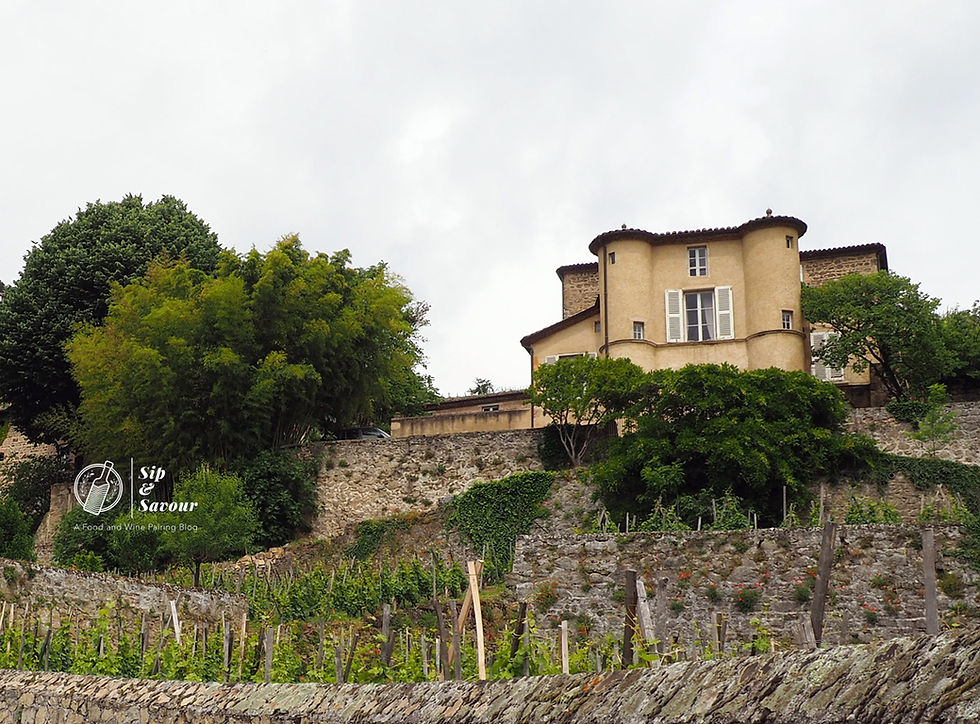
Not to dwell on ownership, it’s just a side note, but 2027 will mark 200 years since the Neyret-Gachet family first acquired Château-Grillet, stewarding the estate for generations and securing its prestigious appellation. Since 2011, it has been owned by Groupe Artémis, the holding company behind major fashion and art auction houses, as well as notable wine estates such as Château Latour, led by François Pinault - yes, the same monsieur married to Salma Hayek.
So naturally, when we lived just an hour away, we were thrilled at the chance to visit the estate.
My husband raved about paradise on earth. I was along for the ride, clueless but enthusiastic.


While specialized wine tours or professional visits can sometimes be arranged at the château, most sensible people plan the trip with tastings at other Northern Rhône producers in nearby villages, done directly or through partner wine cellars.
Just a few tasting spots:
Vignoble Deleu: Family-run vineyard in the centre of Condrieu, offering Rhône wine tastings.
Domaine Niero: Tasting of Condrieu and Côte-Rôtie wines in the cellar.
Clos de la Bonnette: Intimate tasting experience in Condrieu.
Domaine de Corps de Loup: Known for Condrieu and Côte-Rôtie wines.
Le Caveau du Château (Ampuis): Nearby, with a large selection from prestigious houses like Guigal or Vidal-Fleury.
Other notable wineries nearby: Ferraton Père & Fils and Pierre Gaillard.
We, naturally, did not do the sensible thing.
Instead, we drove straight up to Château-Grillet. The usual gates were nowhere to be seen. And, even more surprisingly, the place was completely deserted. Not a soul. We wandered around the grounds for a couple of minutes, trying to look as though this was all part of the plan. Fortunately, the gendarmerie were probably savouring a long French lunch, leaving us free to slink away unpunished and mildly embarrassed.
On the bright side, the view from the granite terraces over the Rhône was absolutely majestic - arguably the most exclusive part of the experience we were actually allowed to enjoy.
And honestly, I can’t blame them. Here’s why:

The estate produces fewer than 10,000 bottles a year of its flagship wine, the Vin Blanc de Château-Grillet. (They do also make a Côtes-du-Rhône Blanc, the Condrieu "La Carthery", and even a couple of brandies.)
And then comes the patience test. Château-Grillet wines are released only after 8 to 10 years of aging , sometimes longer. So those "recent" vintages everyone mentions - 2014 to 2016 - are only just appearing around 2024 to 2026 (if my wine math hasn’t completely betrayed me).
By the time you finally see a bottle, it has already lived a full, elegant life - possibly more accomplished than most of us. It’s one of the longest-lived Viogniers out there… and apparently one of the hardest to actually encounter, unless you’re dining somewhere with more Michelin stars than you can comfortably count.
Unsurprisingly, the price is stratospheric. Recent bottles sell for €300–€500, and older vintages are practically mythical treasures.
A quick web search even revealed a tiny selection tucked away in a couple of SAQ stores in Quebec - a reminder that this liquid legend occasionally crosses the ocean and even makes it onto retail shelves!
My only consolation? Imagining that somewhere, at least, a bottle is being poured for the incomparable Salma Hayek - who, I assume, did make a reservation.
One more thing: Château-Grillet’s signature slim brown bottles are instantly recognizable and unlike anything else used by French wineries. And the labels? (Graphic designer here, speaking up.) Endearingly simple. Almost suspiciously unchanged, like someone decided decades ago: "This is perfect. Why confuse people with updates?" When your wine is basically liquid legend, a redesign is optional.
Viognier
Luckily, other Viognier bottles - from France or beyond - are within reach. Whether you’re in Calgary or anywhere else, just ask for a bottle of vee-own-YAY and enjoy!

Viognier is a highly aromatic, full-bodied white known for its intense floral and fruit notes.
Aromas of apricot, ripe peach, honeysuckle, and white flowers and flavours of mango, guava, peach, pear, citrus (lemon/lime), and honey.
Originally from the Rhône Valley - where this whole adventure brought us - it often has a rich, almost creamy texture with relatively low acidity, giving it that lush, opulent feel on the palate.
Clearly, I have a soft spot for this style of wine… and I may have already gone on about it just a little too much here:
But! Viognier is a tricky grape. Pick it too early, and the wine is flat and boring. Wait too long, and it turns into a heavy, boozy, oily mess. No pressure.
What makes it even more fascinating is its survival story. By the 1960s, Viognier was almost extinct, clinging to life in this tiny corner of France, Condrieu. Today, it’s making a full-blown comeback, showing up in California, Australia, South Africa, you name it. From has-been to global star, it’s had quite the glow-up.
And here’s a fun twist: Viognier sometimes sneaks into red wines too - specifically in the neighbouring Côte-Rôtie AOC, where it’s blended with Syrah to boost aroma and help stabilize colour. It’s a little personality contradiction as on its own, Viognier is typically dry, yet it smells like dessert.
Food Pairing
Serve lightly chilled (10–12°C) to preserve Viognier’s delicate aromas.
Food pairing suggestions for Viognier often start with the classics: spicy food.
Such as Thai dishes, Moroccan tagines, curries, anything with a bit of heat. That advice is absolutely valid. Viognier’s lush texture and aromatic intensity can handle spice like a pro.
But let’s not forget its roots. Long before global cuisine entered the chat, this Rhône-born beauty was happily paired with French dishes, following that simple, time-tested rule: what grows together, goes together. And it still works beautifully. Think roast chicken or turkey breast, lobster, shrimp, crab, pork chops with apricot sauce, or even poached salmon. On the vegetable side, it shines with fennel, leeks, cauliflower, pumpkin, olives, and sweet peppers. Add in herbs and spices like tarragon, ginger, nutmeg, or herbes de Provence, and you’re in very good company.
And then there’s cheese! Viognier pairs wonderfully with creamy, soft, or goat cheeses. It balances the richness of triple-creams like Brillat-Savarin or Délice de Bourgogne and complements fresh or lightly aged goat cheeses as well. Young Comté or Gruyère work nicely with its nutty hints, and for the adventurous, a mild blue like Fourme d’Ambert offers a delightful sweet-salty contrast.
Take a look at my Calgary cheese shops suggestions here.
Or! you could grab some local cheese, a baguette, pop open a bottle of Viognier, and have yourself a picnic somewhere along the Rhône ... or the Elbow. Simple, unpretentious, magical.
That’s exactly what we did after the Château-Grillet fiasco. Santé!
Happy sipping and savouring!

Comments