

Chablis & Jambon Persillé in Aspic… or, as it’s known outside France, Good Old Leftover Christmas Ham in Jelly
- Dec 30, 2025
- 7 min read
Chablis, that crisp, elegant, raised by monks, minerals, and a smug little breeze Chardonnay from the northernmost edge of Burgundy and Jambon Persillé form a pairing so perfect it feels like French has been quietly perfecting ham-and-wine science for centuries. Respect.

Christmas Ham is a little tradition in our house. I usually make it on the 25th, once the Christmas Eve fish dishes have vanished and everyone is ready for something a bit heartier. And from that gloriously large pork butt roast, there are always leftovers.
Which brings me to one of my quiet pleasures: serving them suspended in a delicate, shimmering jelly. Yes, gelatin, the same collagen everyone now buys in fancy jars and stirs into overpriced smoothies.
Long before it became a "wellness trend", it was simply the logical, delicious way humans made use of the whole animal.
Call me old-fashioned, but I adore a beautiful ham in aspic. It feels timeless, slightly nostalgic, and, if you ask me, absolutely perfect.

A little clin d’œil (pardon my French, I meant a nod) to my Hungarian upbringing:
Kocsonya (KOH-chohn-yah), the proudly rustic, wonderfully wobbly cousin of fancy French jambon persillé. It may not have the elegant name, but trust me, it’s every bit as delicious. While the French suspend their ham in refined, parsley-speckled aspic, we Hungarians go straight for full-on, no-nonsense jelly glory. Head to toe pork trotters, ears, tails, skin, sometimes knuckles or ham hocks… if it makes good collagen, it’s invited to the party. Served cold in the heart of winter, often around Christmas, kocsonya is a beloved, deeply nostalgic dish for many Hungarians. I adore both versions, the chic French terrine and the wobbly Hungarian classic.
(Even though certain members of my family, who will remain very diplomatically unnamed, absolutely hate it, and do so very loudly.)
So. Jambon persillé is, at heart, just fancy ham trapped in parsley jelly, a terrine if you’re French, a mysterious wobbling meat brick if you’re not. It’s rich, savoury, faintly herbal, and unapologetically jiggly, the kind of dish that quivers slightly when you look at it too hard.
Enter Chablis, which slices through all that porky richness like a crisp, lemony lightsaber, restoring balance to the universe.
Traditionally, this dish belongs to Easter, not Christmas, a practical end-of-winter solution to the problem of "we still have a lot of salted ham". The explosion of green parsley wasn’t just decorative; it symbolized spring’s return, fresh grass, new life, and the general relief that winter was finally over. These days, however, jambon persillé has escaped the calendar and is eaten year-round, because Burgundy wisely decided that waiting was unnecessary. Chablis remains its ride-or-die companion.
The dish itself is seriously old: a centuries-old Burgundian specialty, most closely associated with the Côte d’Or and documented as early as the 14th century, back when jelly was a perfectly normal thing to suspend meat in and no one questioned it.

Then comes the rebellious modern chapter.
In the 20th century, a variation called Jambon à la Chablisienne appeared, which is basically the same ham, but cooked in wine, because the French refuse to let a good Chardonnay sit quietly in a glass. This richer dish loves a slightly older Chablis, preferably 3–5 years old and full of philosophical complexity. It’s credited to Charles Bergerand, descendant of a master saucier to King Louis-Philippe, which in France means the recipe arrives with impeccable pedigree, a flourish of the wrist, and at least one dramatic family anecdote. This version includes Chablis and crushed tomatoes, boldly proving that Burgundy can flirt with innovation… as long as it’s supervised, approved by history, and done very politely.
The Chablis Wine Region

Let’s clear something up right away:
Chablis is Chardonnay.
Chablis (pronounced Shah-blee) is a world-famous white wine region tucked into the northernmost reaches of Burgundy, France, where grapes grow with a cardigan permanently on. The result? Wines of startling purity, high acidity, and that famously "steely" minerality that makes sommeliers sigh happily and seafood feel emotionally complete.
The wines here are made exclusively from 100% Chardonnay, yet they taste nothing like the buttery, oak-heavy versions many people associate with the grape. Instead, Chablis is prized for its purity, high acidity, and unmistakable "steely" minerality.
The Chardonnay Plot Twist
If your experience with Chardonnay involves words like buttery, toasty, or vanilla bomb, Chablis is here to quietly judge that experience, then offer you a lemon slice and a mineral snap instead.


While many Chardonnays are aged in oak and lean rich and creamy, Chablis is usually fermented in stainless steel, preserving crisp fruit and razor-sharp freshness. Think:
Green apple
Lemon zest
White flowers
Wet stones after rain
Oyster shells (yes, that’s a thing, and yes, it’s delightful)
It finishes clean, long, and slightly tingly, like your tongue just walked past the sea.
The Four Levels of Chablis (A Very Polite Hierarchy)
Like all good French things, Chablis comes with a ranking system:

Petit Chablis
The lightest and freshest style: bright, easy, and meant to be enjoyed young. Often grown on higher plateaus with different soils. Think aperitif energy.
Chablis (AOC)
The classic, everyday Chablis: balanced, mineral, and unmistakably itself.
Chablis Premier Cru
From 40 specific vineyard sites/"climats" with better sun exposure. More concentration, more depth!
Chablis Grand Cru
The pinnacle. One sun-drenched slope. Seven legendary climats (Les Clos, Bougros, Preuses, Vaudésir, Grenouilles, Valmur, Blanchot). Often sees oak, ages beautifully for 10–15+ years, and makes collectors weak at the knees.
Terroir: Because Rocks Matter
Chablis owes its distinctive personality to its soils: a complex mix of limestone, marl, and fossilized oyster shells. In a very real sense, this is wine made from sunshine filtered through prehistoric seabeds.
That soil story shifts depending on the appellation. Petit Chablis comes from higher, wind-swept plateaus with younger Portlandian limestone, producing wines that are light, crisp, and straightforward. Chablis AOC covers a wider range of sites, many of them rooted in Kimmeridgian soils, which give the wines their classic balance of freshness and minerality. At the top, Premier Cru and Grand Cru vineyards, firmly anchored in Kimmeridgian limestone, deliver the greatest depth, complexity, and aging potential.
This is why Chablis tastes like somewhere, not just something.
What to Eat With It (Short Answer: Yes)
Thanks to its high acidity and saline edge, Chablis is the undisputed champion of oysters. But it’s equally brilliant with:
Scallops, shrimp, lobster
Roast chicken (especially with herbs or cream)
Goat cheese, Comté, Beaufort
Sushi and light Asian dishes
And, naturally, jambon persillé, where it cuts through richness like a lemony lightsaber.
Jambon persillé: Young Chablis. Chic, crisp, does all the heavy lifting.
Jambon à la Chablisienne: Older Chablis. More depth, more drama.
Chablis also loves: seafood, escargots, charcuterie, poultry, light cheeses, basically everything except your New Year’s resolutions. In summary: If dinner is pale, cold, or wobbling slightly… Chablis will make it feel intentional.
Chablis is Chardonnay stripped of makeup, oak, and drama. Left alone with its place, its climate, and its rocks. It’s elegant without trying, refreshing without being simple, and endlessly food-friendly.
And best of all?It regularly converts I don’t like Chardonnay-people, often without them even realizing it.
Which is, frankly, the most French move of all.

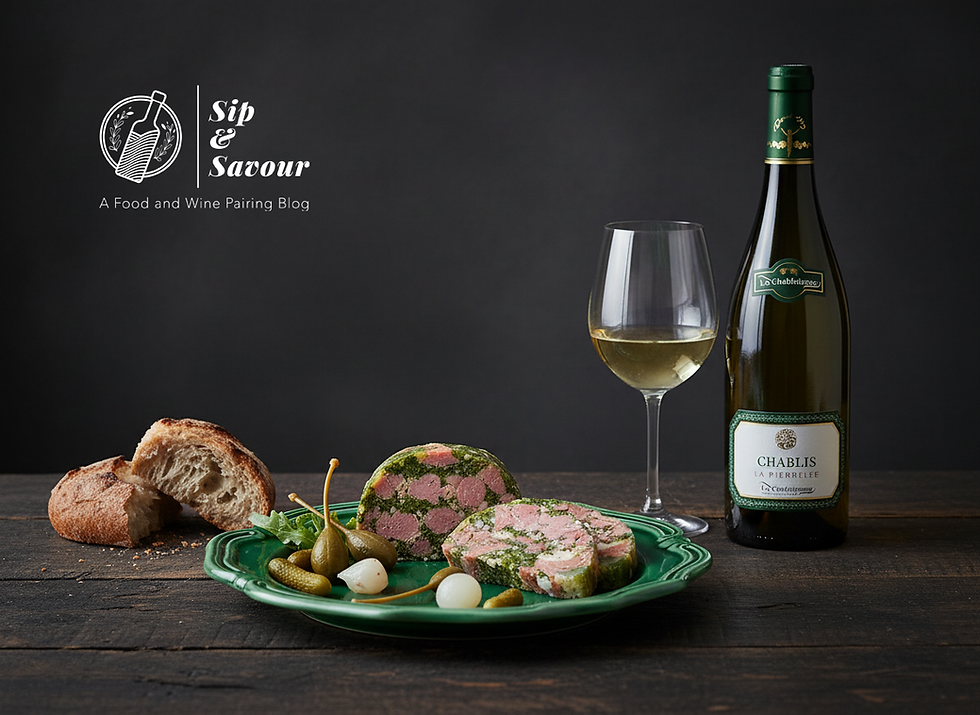
We went with a bottle of Chablis “La Pierrelée”, a classic, no-nonsense Chablis from La Chablisienne, the highly respected cooperative founded in 1923. Made from 100% Chardonnay, it’s fresh, mineral, and unmistakably Chablis: bright citrus, green apple, a touch of white peach, and that salty, flinty finish that tastes like it grew up on rocks (because it did). “Pierrelée” literally means stony - a nod to the region’s famous Kimmeridgian limestone soils, packed with ancient oyster shells and responsible for that crisp, sea-breeze character.
This was the bottle I found quietly waiting in the cellar: not flashy, not grand cru, not demanding reverence. Also, I wasn’t emotionally ready to open the more prestigious ones anyway. La Pierrelée is elegant but approachable, the kind of Chablis that works beautifully as an aperitif or with all of the dishes mentioned above, and of course, jambon persillé, without making you feel like you should be taking notes.
It has the soul of Chablis, without the drama. And sometimes, that’s exactly what you want.
Jambon Persillé
SERVINGS 6 | Preparation: 30 minutes | Cooking: 3 hour | Cooling: 6 hours
Ingredients
1 kg / 2.2 lb smoked pork shoulder or ham
1 naturally gelatin-rich pork cut (pig’s foot, but let’s keep that detail off the menu for those too sensible)
For the Aspic, if the pig’s trotter isn’t used: 2-3 packets of unflavoured gelatine (about 20 g)
1 litre / 4¼ cups / 34 fl oz water
500 ml / 2 cups / 17 fl oz dry white wine
Salt, to taste
1 medium onion
2 garlic cloves
1 leek (optional)
1 bouquet garni (thyme, bay leaf, parsley stems)
10-12 black peppercorns
small splash of white wine vinegar
1 large bunch flat-leaf parsley, finely chopped (about 1½–2 cups)
Method
Place the ham hock (and the pig’s trotter, if using) in a large, heavy-bottomed pot and cover with cold water. Bring slowly to a boil over medium-high heat, skimming off any foam that rises to the surface.
Lower the heat to a gentle simmer and add onion, leek, garlic, bouquet garni, and peppercorns. Season lightly with salt, keeping in mind that the ham will release its own salinity. Simmer for 2 to 3 hours, until the meat is meltingly tender and easily pulls away from the bone.
Remove the ham hock and trotter from the pot and set aside to cool slightly. Strain the cooking liquid, discarding the vegetables and aromatics. If a pig’s trotter was used, allow the strained broth to cool; it should naturally begin to set. For a clearer finish, strain once more through fine cheesecloth.
If no trotter was used, let the broth cool slightly, then dissolve the gelatin according to the package instructions and stir it into the warm liquid.
Once the meat is cool enough to handle, shred or cut it into bite-sized pieces, removing excess fat or gristle. Finely chop the parsley and fold it evenly through the meat. If desired, add a small splash of white wine vinegar to lift the flavours.
Spoon a layer of the ham and parsley mixture into a terrine or loaf mold and ladle over just enough broth to cover. Repeat the layering until the mold is filled, finishing with a final layer of broth to bind everything together.
Cover tightly and refrigerate for at least six hours, preferably overnight, until fully set.
To serve, run a knife around the edges of the mold and gently unmold the terrine onto a platter. Slice and serve chilled.
Serve it chilled, with some green salad, pickles/cornichons, dijon mustard, and crusty baguette.
Happy sipping and savouring!


Comments