

The Basque Country: Exploring Spain through Art, Wine and Bites
For some reason, I always end up in Spain during the winter. Not a tragedy. I am firmly not a beach person, but still hilarious considering this is the land of Costa-del-You-Should-Really-Be-Wearing-A-Bikini. Meanwhile, I’m over here wrapped in three scarves, insisting that winter is the superior season for eating anyway.
The Basque Country
This December–January trip turned into a road trip through France and Spain, with a few days in the French Basque Country - le Pays Basque. It’s an odd, wonderful place where mountains tumble into the sea , houses look like they were designed by elves, and breakfast in Bayonne can absolutely involve blood sausage (more on that sacred breakfast later).
This fiercely proud, delightfully stubborn region refuses to belong to just one country, stretching effortlessly across both Spain and France. Its people speak Euskara, a language so singular it seems designed to puzzle linguists and humble tourists alike - something I, as a Hungarian, immediately relate to. With their own traditions, their own pace of life, and a deep devotion to food, I find Basque culture truly fascinating.

On the Spanish side (also called Euskadi), cities like Bilbao, San Sebastián, and Vitoria-Gasteiz offer a mix of striking architecture, dramatic coastlines, and lively debates about which bar serves the best pintxos.
Euskadi on both side of the border is a place where food is sacred, identity is non-negotiable, and a night out can easily end with wine, wandering, and a suspicious number of toothpicks in your pocket.
In short: two countries, one soul, and absolutely no patience for bad food. It remains my favourite part of both, and food is approximately 93.7% of the reason.
We arrived just after Christmas. San Sebastián (Donostia) at night felt like a perfectly styled winter postcard: light frost, the Bay of Biscay in moody grey, and leftover holiday lights glowing softly along the streets. By morning, sunshine revealed an elegant seaside city that refuses to hibernate.
Bilbao, by contrast, had that cold, steely light that makes modern architecture feel faintly judgmental. The Guggenheim shimmered along the Nervión River - Frank Gehry’s design all sweeping curves and quiet confidence, as if it knew I’d been waiting my whole life to see it.
Outside, sculptures invite wandering before you even step inside. I made several earnest attempts to photograph Louise Bourgeois’s giant spider, Maman, which tourists had cheerfully rebranded as an interactive climbing structure. People clung to its legs with impressive confidence. I watched from a polite distance, briefly wondering if I, too, could just… hop on. For research.
But no. I didn’t. I couldn’t. I am, after all, an art historian.
Instead, I stood there "waiting for the right moment", which in this case meant quietly judging everyone while taking almost no photos. I left with frozen fingers, unusable images, and the quiet satisfaction of having respected the artwork.
Now, yes, modern art. I’ve already admitted I tend toward the old masters. But if you’re travelling with children, even very young ones, visit contemporary museums. Ours have always been far more engaged: bold scale, bright colours, occasional absurdity. It just works. There’s an immediacy that invites curiosity rather than reverence. Even I often find myself laughing alongside them, which feels like its own kind of masterpiece.
For those who feel most at home with older masters, the Museum of Fine Arts of Bilbao offers a remarkable journey through centuries of art. Here, you can discover masterpieces by renowned artists such as Francisco de Goya, El Greco, José de Ribera, and Eduardo Chillida.
Pintxos
Once you step out of the museum, you realize the Basque devotion to art continues- just in edible form.
And that form is: pintxos (PEEN-chos). Tiny, perfect, edible masterpieces.
Winter here isn’t Canadian-cold, but it’s damp in a way that settles into your bones.
Luckily, salvation is everywhere—warm, glowing bars tucked into every corner.
We barely sat down for proper meals, preferring to hop from bar to bar, tasting bite after bite. When each bite is basically a tiny art installation, the idea of a "main course" suddenly feels laughably old-fashioned.
(Bilbao, San Sebastián, and the rest of the Basque Country boast Michelin-starred restaurants, yes. We did not visit. We were far too committed to our toothpick-sized masterpieces.)
And just to clarify: pintxos are not tapas. Close, but not the same.
Pintxos vs. Tapas - a quick guide:
Pintxos are smaller, usually served on bread or skewered with a toothpick, and are a proud specialty of Northern Spain’s Basque Country. They actually have more in common with Venetian cicchetti - individual bar bites meant to be enjoyed standing and hopping from place to place - than with traditional tapas. Tapas are broader in style: small plates of all kinds, typically meant for sharing, enjoyed throughout the rest of Spain.
Post-Christmas streets were lively in that unforced way that feels less like a festival and more like everyday life. People wandered, laughed, drank, and gathered. Wine flowed, lights lingered, and winter became the perfect excuse to stay out just a little longer.
The quality is remarkable—and refreshingly affordable. What might cost $20 elsewhere is often just a few euros here. A glass of wine? Also a few euros. Dining feels less transactional, more like a public service.
Every bar felt like a gallery opening where the art is edible and no one judges you for drinking wine at eleven in the morning.
Winter in the Basque Country may not come with beaches, but it offers something better: excellent wine, glowing bars, and enough gildas to make you reconsider owning a swimsuit.
Speaking of gildas! Here’s the recipe for the tiny classic Basque pintxo:
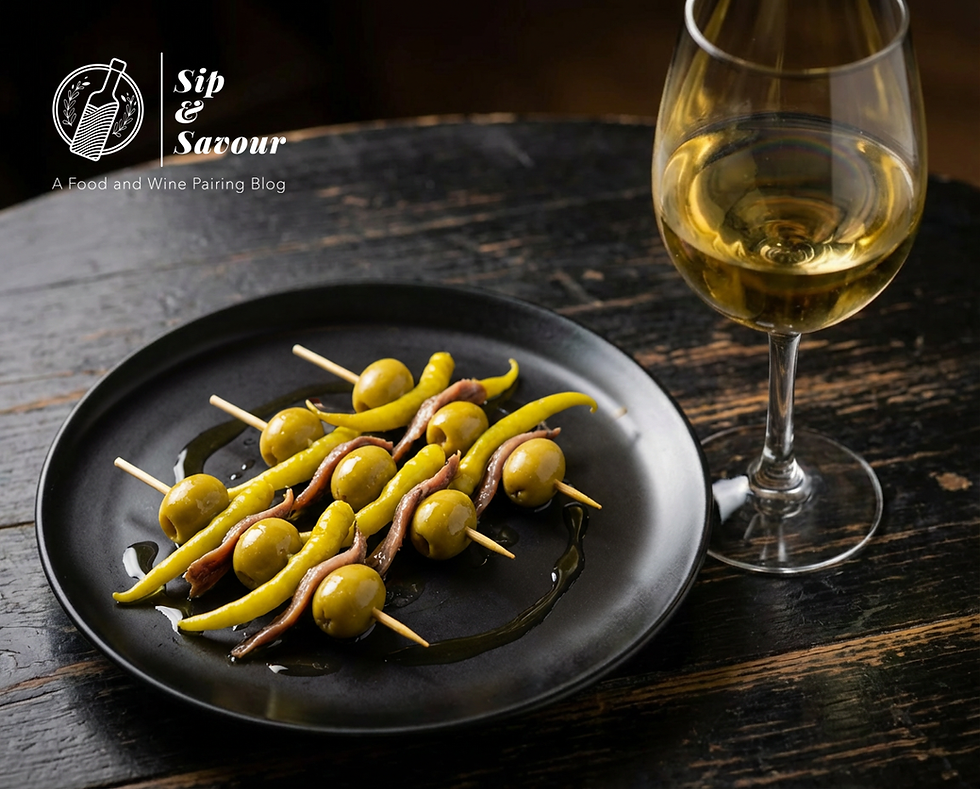
Gildas
The classic Basque pintxo
Salty, briny, and slightly spicy, gildas are the region’s iconic bite. Perfect with vermouth or a crisp white.
This version is called a "matrimonio".
Ingredients: green olives, pickled guindilla peppers, oil-packed anchovies, marinated anchovies, olive oil.
How: Skewer an olive, oil-packed anchovy, pepper, marinated anchovy, another pepper, and finish with an olive. Drizzle with excellent olive oil and serve.
Eat immediately. Preferably standing.
Txakoli
The local wine star is Txakoli (cha-ko-LEE), a zippy coastal white that practically sparkles. It’s bright, crisp, and lively, with notes of lime, green apple, peach, floral blossoms, and a hint of saline minerality. Light-bodied, high in acid, and low in alcohol.
Other than (most) pintxos, Txakoli pairs beautifully with:
Seafood: With its bright acidity, crisp dryness, and subtle citrus and mineral notes, Txakoli is the ideal white wine for everything from raw oysters to prawns and crab.
Soft Cheeses: Txakoli’s zesty acidity and fresh green flavours create a perfect contrast for mild, buttery cheeses like brie, goat cheese, camembert, or ricotta. The wine lifts the flavours of the cheese, making each bite even more delicious.

Astobiza Txakoli, from the estate in Okendo, Álava, is a shining example: vibrant, balanced, and versatile, pairing beautifully with anything from oysters to lightly spiced dishes. Sustainability and tradition guide every step, and it’s even available in Alberta, making it easy to enjoy a little Basque magic at home.
Photo credit: Astobiza Estate
Founded by the Abando-Moyua family, this estate is nestled in Okendo, Álava, just thirty minutes from Bilbao, within the Txakoli de Álava designation of origin.
The vineyard spans ten hectares, thoughtfully divided into seven micro-plots at 250 meters above sea level. Surrounded by mountains, the site enjoys natural protection from valley fog and winter frost, creating ideal growing conditions.
Working exclusively with indigenous varieties, the team approaches both viticulture and winemaking with precision and care. Their philosophy is rooted in sustainability, respect for tradition, and minimal intervention.
Harvest is timed to capture peak aromatic expression, with grapes handpicked into small boxes and meticulously sorted, ensuring purity, quality, and a true reflection of the land.
All in all, the Basque Country captured my heart. Mountains, coastlines, pintxos, they’ve all lodged themselves firmly in my imagination. Next time, I’ll aim for spring or fall, when the countryside is calling with vineyards and sun-dappled roads to explore. There’s so much more to see, taste, and experience and I can’t wait to return.


Comments