

From Fresco to Fermentation: Italian Masters and Wine in Parallel
Updated: Sep 7
Art is often called food for the soul. Wine is praised in much the same way. The metaphor may be worn thin, yet in Italy it feels effortlessly true. Art isn't confined to museum walls; it spills into churches, cafés, and quiet piazzas, while wine flows through long conversations, family tables, and centuries-old traditions. You don’t go hunting for either one, not exactly. You just… arrive. Then you find them the way you find a street you didn’t know existed, the way you stumble onto shade you didn’t notice you needed. In Italy, beauty doesn’t behave like a luxury. It behaves like something you live inside. It threads through everything - between a glass of wine and a sunlit corner of stone.
Carpe diem, carpe vinum
I've just come back from a week in Rome, and I'm still carrying the rhythm of the city with me. Art wasn't something we squeezed in between meals or aperitivo, it was the reason we went.
Also, it was our first trip without the kids.
The last time we followed this kind of itinerary, they were still small enough to be bribed through museums with gelato. They survived churches, ruins, and long explanations about frescoes with a kind of exhausted dignity that I still admire, even now, even after the fact.

Rome was crowded, and the heat was relentless—the kind that makes the air look shimmery above the cobblestones, like the city is being stirred. It should’ve made everything miserable. And yet the longer we stayed in it, the more the discomfort stopped being the main story. The moment you got absorbed, the city softened around the edges. Not the heat. Not the crowds. Just… you. It let you forget yourself.
What’s left for me now is a thread that doesn’t break. The past doesn’t feel like history there. It feels like something still standing in place while everything else moves around it.
A scrap of carved detail on a building corner.
Mary, silhouetted against a cloud so perfect it looks placed.
An ancient monument that’s been there for nearly two thousand years, watching the world reinvent itself over and over, while it stays steady, like it doesn’t need to prove anything.

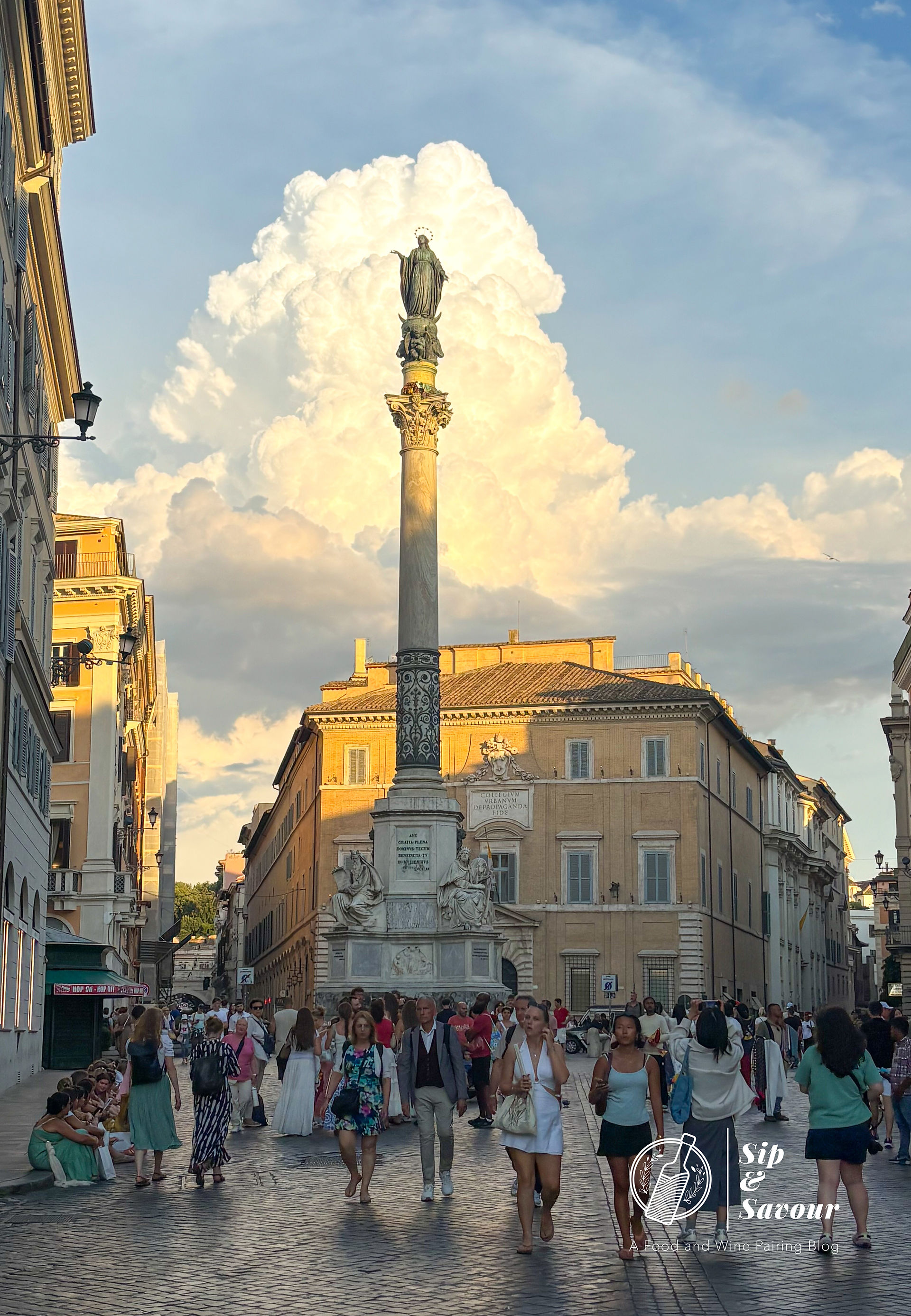


Casa Manlia, Palazzo di Manilio | The Column of the Immaculate Conception | Caffè Martini Colosseum / Trastevere
Credit: sipandsavour.blog
The odd thing is how unremarkable it all feels to the city itself. People pray beneath world-famous paintings. Sip espresso next to triumphal arches. Sell trinkets just steps from where Caesar met his end. That may be one of the most Italian things about Italy. The extraordinary is simply folded into the everyday. Nothing feels staged. It just unfolds, alongside everything else.
Wine works much the same way.
It isn’t an event. It’s lunch. It’s dinner. It might appear at 11 in the morning, and nobody seems especially interested in explaining why.
It’s part of the rhythm, not an interruption to it.
Italian Art and Wine: Matching Famous Artists with Italian Wines
And somewhere between museum mornings and those long, gloriously unfussy dinners, I started playing a little game.
What if Italian art and Italian wine were, in some strange way, speaking the same language?
Not historically. Not literally. And certainly not according to any art-historical rulebook.
I mean temperament.
Colour. Texture. Mood. Drama. Restraint. Excess. A particular way of looking at the world.
The more I thought about it, the more obvious it seemed: what if Italy’s great artists could each be introduced through a glass of wine from the landscapes they once knew?
So I started matching them.
Michelangelo with one wine. Caravaggio with another. Titian with another.
Some pairings are obvious. Others took a little more convincing.
And before the art historians and wine purists sharpen their pencils, there is one thing we should get out of the way. Many of these artists never tasted the wines I’ve paired with them. Amarone, Prosecco and the Super Tuscans, for example, are relatively modern creations.
But the places themselves are not. Veneto, Tuscany, Campania, Sicily and the other regions behind these wines have been growing grapes and making wine for centuries, in some cases since Roman times, and often long before.
There is another small wrinkle. Italy, as a unified country, didn’t exist until 1861. Giotto, Leonardo, Michelangelo, Raphael and Caravaggio lived in a peninsula divided among republics, duchies, kingdoms and papal territories. They were not, strictly speaking, Italian in the modern national sense.
But the land was there. The hills were there. The vineyards were there. The soils and landscapes that still shape these wines were already part of the world they inhabited.
Titian never poured himself a glass of Amarone. Leonardo almost certainly never sat down to dinner and debated the merits of a Super Tuscan.
Still, they knew wine.
And perhaps more importantly, they knew the landscapes from which those wines came.
So this isn’t an exercise in historical accuracy. It’s something more playful — a way of looking at familiar masterpieces from a slightly different angle.
Art through wine. Wine through art.
Pour yourself a glass, preferably Italian, and let’s wander through the vineyards and masterpieces of Italy.
Giotto - Fiano di Avellino
Every great story has a moment when everything changes. In Italian art, that moment begins with Giotto, whose paintings replaced distant symbolism with something startlingly new: people who looked and felt unmistakably human.

The First Breath of the Renaissance
Before Giotto, much of medieval European painting existed in a world of symbols and divine perfection. Figures floated against golden backgrounds, their expressions solemn and distant, more spiritual than human.
Then came Giotto di Bondone (c. 1267–1337). Born in the hills of Tuscany, Giotto marks one of those rare moments in art history when painting suddenly starts to feel recognizably human.
In the Scrovegni Chapel in Padua, figures no longer float against gold backgrounds like decorative symbols. They stand in rooms, they lean into each other, they react.
And the expressions feel almost too relatable: in The Kiss of Judas, Judas leans in with the awkward determination of someone fully committed to a bad decision, while Christ looks less like a distant divine figure and more like someone quietly thinking, “Well… this is happening”.
Elsewhere, the angels aren’t doing much better. In the Crucifixion and Lamentation, they’re openly distressed, no serene distance, just full emotional overload, like they’ve all agreed things have officially gone too far. It’s surprisingly modern: grief looks like grief, shock looks like shock. No symbolism required.

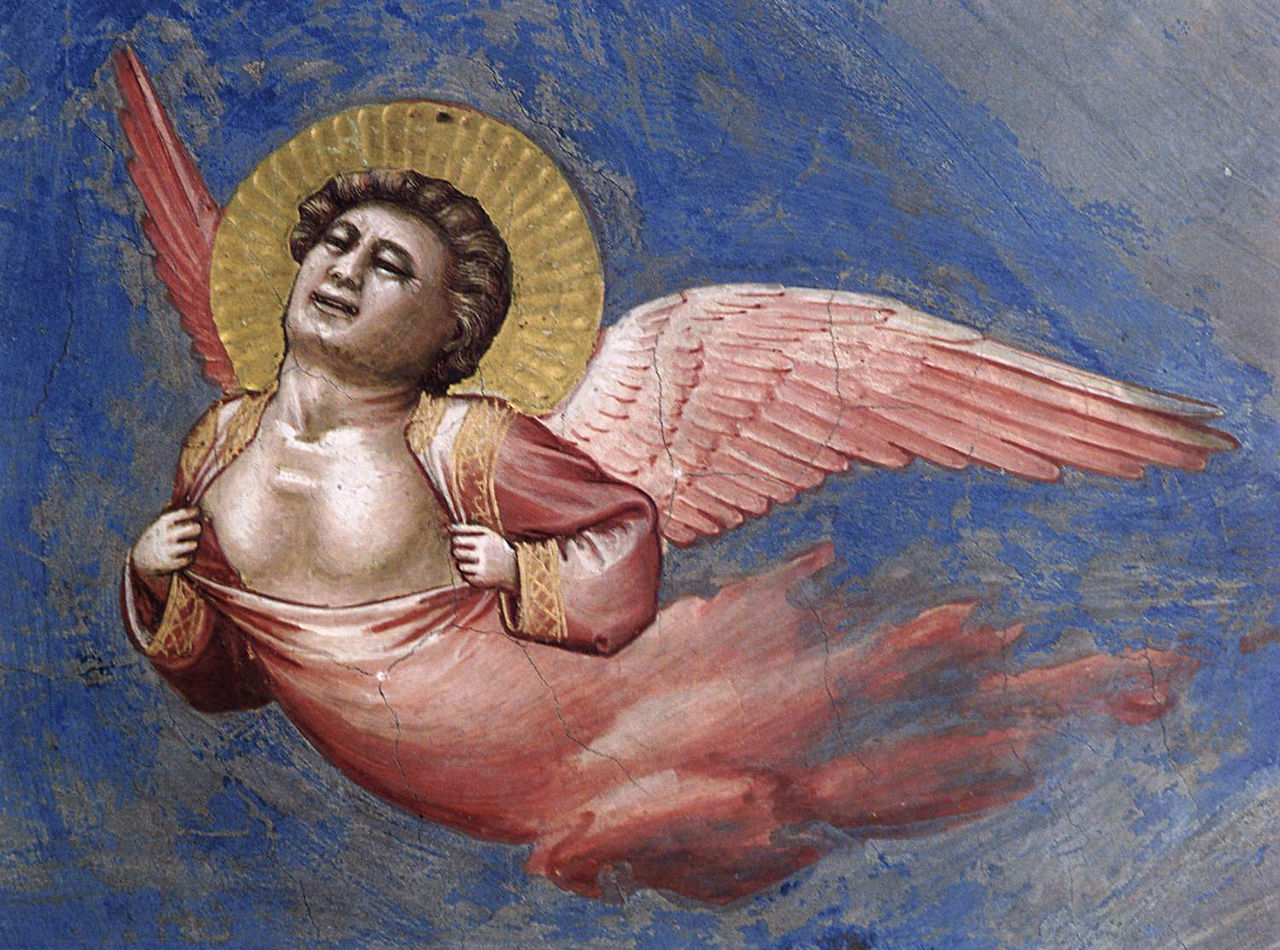

Giotto's frescoes in the Scrovegni Chapel, Padua
What Giotto changes most is presence. His figures occupy space in a way earlier painting doesn’t really succeed at. Bodies have weight, feet touch ground, gestures land with consequence. Even architecture starts to feel believable rather than decorative. Giotto was a transitional figure who bridged the Gothic period and the early Renaissance. Often called the "father of the Renaissance", not because he invented it, but because he changed the terms of painting. With him, art began to represent human experience more directly rather than merely hint at it through symbolic or stylized forms.
If Giotto were a wine, he would be Fiano di Avellino.
The connection isn’t immediate in a flashy way. Fiano doesn’t reveal itself immediately. It doesn’t rely on sweetness or obvious fruit. Instead, it builds shape slowly in the glass: texture, tension, quiet depth.
Like Giotto’s figures, it has presence. Not decoration, but structure, a kind of grounded clarity that holds everything together.
There’s also something about endurance in both. Giotto’s frescoes, still legible centuries later, carry the same sense of permanence you find in Fiano as it evolves with age, becoming more layered, more golden, more complex without losing its core identity.
And perhaps most importantly, both feel rooted. Giotto in the early formation of Italian visual language; Fiano in the volcanic soils of Campania, stubbornly local, true to itself.
Botticelli - Prosecco
From Giotto to Botticelli, only about 150 years pass. Yet rather than a simple progression, it feels as though art itself has changed temperament, becoming lighter, more lyrical, and more concerned with beauty than solemnity.

Beauty, Lightness, and the Joy of Spring
Sandro Botticelli (c. 1445–1510), the great master of the Florentine Renaissance, gave form to a world where reality and dream seem to exist in perfect harmony. His figures move with effortless grace, carried by flowing hair, delicate drapery, and a rhythm that feels almost weightless. In The Birth of Venus and Primavera, everything seems in motion, but nothing feels heavy. Beauty appears without effort, carried on myths, romance, and the quiet promise of spring.

Like Botticelli’s paintings, Prosecco is defined by brightness, ease, and a kind of irresistible charm. Produced in the hills of northeastern Italy across Veneto and Friuli-Venezia Giulia, it’s known for lively bubbles, floral aromas, and notes of green apple, pear, honeydew melon, and honeysuckle. Fresh and approachable, its appeal lies in pleasure rather than weight or intensity.
The connection to Botticelli is in its sense of effortless movement. His figures seem carried by wind and rhythm rather than structure or force, and Prosecco moves in much the same way - light, lifted, and immediate from the first sip.
Neither is concerned with drama or complexity for its own sake. Instead, both value freshness over intensity and elegance over excess.
Like Venus emerging from the sea, Botticelli's paintings leave an impression of lightness and effortless grace. Prosecco does the same by capturing the same distinctly Italian gift for making beauty feel natural, generous, and uncomplicated.
Leonardo da Vinci - The Artist Who Refused to Be One Wine
After Botticelli’s world of brightness and ease, Italian art begins to shift. With Leonardo da Vinci, it becomes more questioning, more layered, and far harder to define in a single line.

Chianti Classico, Super Tuscan, or Vin Santo - The Tuscan Trifecta

Most artists are relatively easy to match with a single wine.
Leonardo da Vinci (1452–1519), however, refuses to fit so neatly. Rather than pairing him with one bottle, it feels more natural to pair him with a landscape: Tuscany.
Tuscany was where Leonardo's mind first took shape. Born in the village of Vinci and later apprenticed in Florence, he grew up in a world where art, science, engineering, music, and philosophy were not separate pursuits but different expressions of the same curiosity.
Although his career took him to Milan, briefly to Rome, and eventually to France, the habits of mind that defined him were formed in Tuscany. If any place speaks Leonardo's language, it is the cradle of the Renaissance itself.
Its wines, then, become different expressions of the same landscape: Chianti Classico for balance, the Super Tuscans for innovation, and Vin Santo for patience and reflection.
Chianti Classico - The Foundation
The strongest starting point is Chianti Classico, the historic core of Tuscany. Built on Sangiovese, it is structured, balanced, and quietly precise. Nothing dominates: acidity, tannin, fruit, and earth sit in careful proportion, each one supporting the whole.
That sense of order feels very close to Leonardo’s thinking. Beneath the beauty of his work lies a mind constantly measuring, observing, and refining. He understood that harmony is rarely accidental, it comes from discipline. Chianti Classico works in much the same way: its elegance is controlled, not decorative, and its strength lies in balance rather than excess.
Super Tuscans - The Innovator
Yet Leonardo never stayed within boundaries for long. He questioned established ideas and pushed into new territory, often far ahead of his time.
That instinct finds a clear parallel in the Super Tuscans. When winemakers stepped outside traditional rules to experiment with new blends and methods, they weren’t rejecting Tuscany’s identity. They were expanding it. The result was a category defined by curiosity and invention, producing wines that broke convention while still belonging to their place.
Like Leonardo, Super Tuscans are driven by exploration. They show what happens when deep knowledge meets the freedom to experiment.
Vin Santo - The Thinker
Then there is Vin Santo. If Chianti represents structure and the Super Tuscans invention, Vin Santo reflects Leonardo’s patience. It is a wine that develops slowly, often aged for years before release, asking for time rather than attention.
Leonardo was equally attentive to process. He studied water, movement, anatomy, light, always focused on how things change rather than how they appear at a single moment. His notebooks are full of observation rather than conclusion.
Vin Santo mirrors that mindset. It doesn’t reveal itself quickly. Instead, it unfolds gradually, rewarding patience with depth and quiet complexity.
As it happens, Leonardo's connection to Tuscan wine isn't merely symbolic. At Villa Da Vinci, near his birthplace, wines are still made from the vineyards surrounding the estate. Their labels feature details from his paintings and sketches.


Better still, Chianti Classico and Vin Santo both date back to the Renaissance, so Leonardo would almost certainly have known wines from the same Tuscan traditions, even if he was far too busy dissecting cadavers, designing flying machines, and painting masterpieces to leave us any tasting notes.
So Which Wine Is Leonardo?
All three.
Chianti Classico reflects his balance. Super Tuscans reflect his curiosity. Vin Santo reflects his patience.
Taken together, they form a more complete picture than any single bottle could offer.
If there is a preference, Super Tuscan might come closest, because Leonardo was, above all, unwilling to stay within limits. But even that answer feels incomplete, which is probably the most accurate way to describe him.
Some minds fit neatly into categories. Leonardo’s never did.
Michelangelo - Barolo
If Leonardo is the mind that refuses to settle, constantly moving between ideas and possibilities, Michelangelo feels like the opposite impulse: everything compressed into form, force, and resistance.

Controlled Force,Compressed Intensity
Michelangelo Buonarroti's (1475–1564) work doesn’t feel like it was made. It feels like it was extracted.
In David , the tension is internal, everything held just before release (the sculpture depicts David before his battle with Goliath). In the Sistine Chapel ceiling, bodies twist through space as if thought itself had physical weight. Even in Moses, there’s a sense that restraint is doing most of the structural work.
The unfinished Slaves make this even clearer. Figures emerge from marble that still refuses to fully surrender them. You don’t see a finished form so much as a negotiation still in progress.
Michelangelo’s idea, that the figure already exists inside the stone, isn’t poetic when you look closely. It feels almost literal. The resistance is part of the work.

Slaves (unfinished), 1519–1534, Galleria dell'Accademia, Florence
The same tension that gives Michelangelo's work its extraordinary energy defines Barolo. Neither reveals itself immediately; both unfold through time, moving from restraint toward expression.
Young Barolo is tight, almost withholding. The tannins dominate early tasting like structure before pleasure. Fruit is present but controlled, as if it’s being kept in check deliberately.
With time, it starts to open, but not evenly. Aromas appear in layers rather than waves: dried rose, sour cherry, something earthy that feels more like memory than flavour. Nothing arrives all at once.
With age, Barolo reaches its fullest expression. The tannins integrate rather than disappear, and what once felt austere becomes layered and expansive. Earth, leather, truffle, and dried fruit unfold with depth, carrying both power and refinement in the same frame.
Like Michelangelo’s figures, it never feels fully relaxed. It moves through stages of restraint, emergence, and depth, revealing itself not at once, but over time, in tension, release, and resolution.
Raphael - Brunello di Montalcino
If Michelangelo was the master of power and drama, Raphael was the master of harmony. Where Michelangelo's figures are full of movement and intensity, Raphael's are graceful, balanced, and serene.

Harmony as Ideal
Brunello di Montalcino is one of Italy's most celebrated wines, admired not for immediate exuberance but for its patience, balance, and quiet confidence. Made exclusively from Sangiovese and aged for years before release, it reveals itself gradually. At first it can seem reserved, but with time it opens into layers of ripe cherry, dried rose, earth, leather, and spice. Its greatness lies not in power alone, but in the way every element is woven into a seamless whole.
That same sense of harmony defines the work of Raffaello Sanzio (1483–1520). Among the great masters of the High Renaissance, Raphael became renowned for compositions of extraordinary balance, where beauty arises from perfect proportion rather than dramatic effect.
In paintings such as The School of Athens, complexity feels effortless. Figures, architecture, and perspective are arranged with such clarity that the eye moves naturally through the scene. Every gesture has purpose, every space feels considered, and every figure belongs. Raphael does not reduce complexity; he organizes it into something calm, coherent, and complete.
Brunello achieves much the same effect. Its structure is firm but never austere, its richness balanced by freshness and elegance. Rather than drawing attention to individual flavours, it allows them to unfold as part of a seamless whole. Like Raphael's paintings, it rewards patience, revealing depth through balance rather than intensity.
In both, harmony is not the absence of complexity but its resolution. Each reminds us that the highest form of refinement is often the least conspicuous, where every part contributes to a whole that feels both natural and inevitable.
Titian - Amarone della Valpolicella / Soave Classico
If Raphael represents harmony brought into perfect balance, Titian begins to loosen that structure, letting colour, atmosphere, and emotion take over.

Titian & Two Wines of Veneto
Few artists embody the richness and versatility of Venetian Renaissance painting like Titian (Tiziano Vecellio) (c. 1488–1576). Born in the Alpine village of Pieve di Cadore, he moved to Venice as a boy and spent almost his entire career there, working from his renowned studio until his death. Over more than six decades, he transformed Venetian painting, evolving from luminous, colour-driven compositions to deeply expressive late works that helped redefine Western art.
One wine hardly feels sufficient to capture that journey.
For Titian's early period, Soave Classico feels like the natural match. Grown in the volcanic hills east of Verona, it is elegant and restrained, with notes of citrus, white blossom, and a gentle mineral edge. There is a clarity to it: light on its feet, carefully shaped, and quietly refined. It reflects a younger Titian, whose compositions remain precise and whose mastery of light is disciplined and controlled. Works from this period include Sacred and Profane Love (c. 1514), Flora (c. 1515), and The Assumption of the Virgin (1516–1518).
Later Titian belongs to Amarone della Valpolicella. Made from partially dried grapes and matured through long ageing, it is deeper, richer, and more textured. Notes of dried cherry, spice, cocoa, and tobacco unfold slowly, with weight and warmth replacing early restraint. The brushwork in his later paintings follows a similar logic. Less defined, more atmospheric, and driven by emotion rather than structure.
Taken together, the two wines trace the arc of his artistic evolution. Yet it is Amarone that leaves the strongest impression. It does not reveal itself quickly; instead, it builds in layers, shifting between intensity and softness. Like Titian in his maturity, it is less concerned with form than feeling, less about clarity than presence. While masterpieces such as Bacchus and Ariadne (1522–1523) and Venus of Urbino (1538) mark the height of his mature style, his late works - including The Penitent Magdalene (c. 1565) - show an increasingly expressive, atmospheric approach that finds its closest counterpart in Amarone's depth and complexity.
What remains constant is his extraordinary command of colour and mood. Even as structure loosens, the work never loses coherence. Instead, it gains depth, as if time itself has become part of the composition.
In that sense, Titian bridges two worlds: the disciplined clarity of the Renaissance and the emotional richness that follows it.
Caravaggio - Taurasi
If Titian's world is defined by colour and atmosphere, Caravaggio's is shaped by light and shadow. A master of dramatic realism, he used light not merely to illuminate his subjects, but to reveal their humanity in all its vulnerability and intensity.

Chiaroscuro and Concentration:The Physics of Drama in Paint and Wine
Michelangelo Merisi, known as Caravaggio (1571–1610), stands at the edge of the Baroque, where the balance of the Renaissance gives way to something sharper, more immediate, and far more human. His paintings are built on chiaroscuro and tenebrism, not just methods of modelling light, but ways of deciding what matters in a scene. Light doesn’t gently illuminate; it cuts in. It isolates a face, a gesture, a moment of recognition, while everything else recedes into shadow.
In his world, darkness is never empty. It holds tension, creates suspense, and gives even the smallest gesture a kind of psychological weight. Caravaggio rarely begins at the beginning. His scenes drop you straight into the middle of things, at the exact point where something has already shifted, or is about to. Ordinary people become participants in moments that feel at once sacred, violent, and intensely real.
There is nothing decorative about his sense of holiness. Saints, soldiers, tax collectors, executioners, they are all rendered with the same uncompromising physical truth. No one is idealised. Grace, when it appears, arrives in the same space as rough hands and tired faces. The sacred doesn’t float above the world; it appears inside it, unadorned and unannounced.
Rome still holds his work in situ. Three churches preserve his paintings exactly where they were meant to be seen, alongside others now housed in the city’s museums. Moving through Rome, you begin to follow him almost unintentionally, from one chapel to the next, each encounter more immediate than the last.
The clearest example is the Contarelli Chapel in San Luigi dei Francesi, where the St Matthew cycle still hangs in its original setting. Standing there, the experience becomes disarmingly direct. The light in the paintings is not simply part of the composition, it is what gives the scene its meaning. Without it, there is no story at all.

Taurasi, Campania’s great Aglianico wine, feels as though it belongs in the same world of forces as Caravaggio. It comes from inland Campania, shaped by volcanic soils left behind by Vesuvius and the region’s deeper geological past. These are lands formed by destruction and renewal at once. Volcanoes erase without hesitation, yet over time they leave behind soil of extraordinary vitality. What once destroyed the landscape becomes the condition for its richness.
Caravaggio’s art rests on a similar contradiction. His paintings are built from conflict: light and darkness, violence and grace, collapse and revelation. Nothing is softened or idealised. Beauty exists not in spite of tension, but because of it.
Taurasi carries that same elemental character. Deep in colour, firm in structure, and layered with black cherry, leather, tobacco, smoke, iron, and volcanic earth, it is a wine of weight and presence. There is no easy generosity here. Instead, there is concentration, intensity, and a sense of power held carefully in balance.
The connection is not simply darkness or depth. It is that both are born from opposing forces. Vesuvius reminds us that destruction and creation are often inseparable. Caravaggio's paintings find light within darkness; Taurasi finds elegance within power. Neither softens the truth. Instead, both show that beauty is often forged under pressure, emerging stronger because of it.
Artemisia Gentileschi - Etna Rosso
From Caravaggio to Artemisia Gentileschi, the shift moves from a more masculine register of dramatic force, like Vesuvius, powerful and destructive, to a more feminine one, like Mount Etna, equally intense but more continuous, alive, and ever-present.

Courage, Fury, and the Female Gaze
Volcanic wines have a way of carrying their landscape inside them: heat, pressure, and time translated into structure rather than spectacle.
Etna Rosso is a clear example. Grown on the slopes of Mount Etna in Sicily, it opens with lift and brightness, almost restrained at first. Then it deepens. Red cherry, wild herbs, smoke, and a stony mineral edge emerge gradually, as if the wine is holding something back rather than announcing itself. There is tension here, but it is controlled, continuous, and alive.
That same quality of controlled intensity runs through the work of Artemisia Gentileschi (1593–c.1656), the great female voice of the Italian Baroque.
Where Caravaggio fractures the scene with sudden illumination, Artemisia builds it with a different kind of force. Her paintings do not erupt outward; they hold inward pressure. Figures are fully present, anchored, physical, unidealised, but what defines them is not spectacle. It is agency. You feel women not as symbols or ornaments, but as participants inside action that belongs to them.
She often paints at moments of decision rather than collapse or shock. The instant just before resolution, where will and consequence are still locked together. The tension is not theatrical; it is internal, concentrated, sustained.
Light in her work behaves less like interruption and more like focus. It clarifies rather than disrupts. It pulls attention toward structure, toward bodies that occupy space with certainty rather than fragility.
Etna Rosso carries a similar temperament. It does not demand attention through force. Instead, it unfolds in stages, revealing depth without breaking its own balance. Nothing is exaggerated, yet nothing is easy.
Even the volcano that shapes it deepens the metaphor. Mount Etna has long been personified in feminine terms in Sicilian tradition - “Mamma Etna”, or the ancient goddess Aetna - an image of power that is not explosive in isolation, but continuous, generative, and self-renewing.
Seen this way, Artemisia’s Baroque is not a counterpart to Caravaggio’s by opposition, but by modulation. If his world is rupture and impact, hers is continuity and held intensity. Both are uncompromising. They simply define force differently.
And there’s a quieter thread running through both her story and the wine as well: resilience. Artemisia built her career against real constraints, while Etna Rosso comes from one of Europe’s most demanding landscapes. In both cases, what lasts isn’t ease, it’s strength shaped over time.
Bernini - Barbaresco
Caravaggio and Artemisia shape drama through light and stillness; Bernini transforms it into movement carved in stone.

Barbaresco and Bernini: Structure in Motion
Gian Lorenzo Bernini (1598 – 1680) had an extraordinary ability to catch change at the exact moment it becomes irreversible.
In Apollo and Daphne, that idea is almost literal: fingers turning into leaves, skin hardening into bark, a body still fleeing even as it begins to root into the earth. It is not simply a sculpture of two figures, but the instant between one state and another, stretched just long enough for transformation to be visible.
That sense of suspended motion runs through his work. In The Ecstasy of Saint Teresa, marble no longer feels like stone. Fabric twists as if still falling, breath seems held mid-release, and opposing states - ecstasy, surrender, resistance - coexist in a single unfolding moment. Nothing settles. Everything is in the act of becoming.
Rome itself feels shaped by this logic under Bernini. Fountains erupt as if frozen mid-motion, chapels stage revelation, and architecture becomes less a frame than a performance space.
That same idea of transformation finds its counterpart in Barbaresco.
Often called the “Queen” of Piedmont wines, Barbaresco sits in contrast to Barolo - and offers a different expression of the same grape, Nebbiolo. Where Barolo can feel dense and restrained in its youth, Barbaresco is more immediate: more perfumed, more open, more expressive from the start.
Part of this comes from its landscape. The soils of the Barbaresco zone, with their higher sand content, tend to produce softer, more supple tannins. The result is a texture that feels less like structure alone and more like form coming alive, closer to flesh over bone. Like Bernini’s marble, it gives the impression of softness emerging from something inherently rigid.
There is also a visual quality to Barbaresco that feels almost deceptive. Its colour is often lighter and more translucent than Barolo, yet the aroma rises quickly and expansively: rose, white pepper, liquorice, dried herbs. It creates a sense of lift that belies its underlying depth, much like Bernini’s ability to make stone feel airborne.
At its core, the parallel is simple: Bernini turns marble into motion caught mid-becoming; Barbaresco turns structure into something immediately alive. Both belong to a Baroque world where nothing is ever fully still, only continuously unfolding.
Canova- Franciacorta
From Bernini’s charged motion, the Baroque gradually cools into something more restrained in Canova’s Neoclassicism.

Lightness, Grace, and Effortless Form
Franciacorta is Italy's most refined sparkling wine. Produced in the rolling hills of Lombardy using the traditional method, it combines fine mousse, vibrant freshness, and remarkable precision. It feels almost weightless in the glass, yet that elegance is the result of years of patient ageing and meticulous craftsmanship.
Antonio Canova (1757–1822) achieved something remarkably similar in marble. His mythological figures, dancers, and noblewomen seem to defy the weight of stone, carrying a quiet grace that appears completely natural. Nothing feels forced, yet every gesture, fold, and contour is the product of extraordinary control.
The connection lies in this shared illusion of effortlessness. Franciacorta's refinement is earned through time, discipline, and precision, just as Canova laboured over marble until it appeared soft, fluid, and almost alive. In both, true mastery conceals the work behind it.
Like a Canova sculpture, a great Franciacorta feels light but never slight: elegant, balanced, and quietly enduring.
Modigliani - Lagrein
From Canova’s polished stillness, art gradually loosens its classical restraint and moves toward the elongated modernism of Modigliani.

Elegance, Melancholy, and the Art of Restraint
Amedeo Modigliani (1884–1920) reduces form until only essence remains. Few artists developed a visual language as immediately recognizable as Modigliani’s: elongated necks, almond-shaped eyes, tilted faces, and figures that seem suspended between elegance and melancholy. Working in Paris in the early twentieth century, he stripped portraiture down to its emotional essentials, creating subjects that feel at once intimate and distant, fragile and self-assured.
Lagrein comes from the north of Italy and carries a distinctive sense of place. Native to the alpine landscape of Alto Adige, it is a wine of depth rather than exuberance, known for its dark colour, velvety texture, and quiet intensity. There is an understated refinement to Lagrein that resists easy categorization, much as Modigliani’s portraits stand apart from the major artistic movements of his time.
The parallel lies in their shared combination of elegance and mood. Modigliani elongated forms not to make them more realistic, but to make them more expressive, creating portraits that feel stretched toward poetry. Lagrein achieves something similar through flavour and texture. Beneath its dark fruit and soft tannins is a subtle tension, a note of introspection that lingers long after the first impression. Like one of Modigliani’s portraits, a great Lagrein is graceful, haunting, and quietly unforgettable.
A Final Toast to Italy
I chose these eleven artists and sculptors because they are, to me, the crema della crema. Not as a definitive list, and certainly not as a ranking, but simply as a way of exploring the conversation between Italian art and wine without trying to tell the whole story. The truth is, the deeper you go into Italy, the more you realise that any list is only a starting point.
From Giotto's first steps toward perspective to Modigliani's modern lines, Italian art doesn't move neatly from one chapter to the next. It branches, circles back, reinvents itself, and somehow remains Italian throughout. Every generation adds another layer without erasing what came before.
Italian wine feels much the same. A crisp Soave, a patient Barolo, the richness of Amarone, the effortless elegance of Prosecco. Each expresses its landscape in a different voice. They're not simply wines to drink, but places, histories, and traditions poured into a glass.
In the end, I don't think this is really about comparing artists with wines at all. It's about paying attention. The longer you spend with a great painting - or a great bottle - the more it reveals itself. Neither rewards rushing. Both ask for curiosity, patience, and a willingness to look, or taste, one more time.
Perhaps that's why Italy captivates us so completely. It teaches you that beauty isn't something to consume quickly or tick off an itinerary. It's something to linger over.
Saluti! 🍷
Prologue: An Evening in the Taverna

The first jug of wine had barely been poured before Giotto raised his cup.
Giotto: "To painting people who finally look like they're standing on the same earth as the rest of us."
Botticelli smiled. "Perhaps. But they still hadn't discovered spring."
A ripple of laughter circled the table.
Leonardo da Vinci, turning a wine jug in his hands, asked, "Have you noticed? The shape of this vessel distributes the weight perfectly. I wonder if..."
Michelangelo interrupted. "Leonardo, for one evening, can something simply be a jug?"
"It can," Leonardo replied, "but it could also be improved."
Raphael raised his glass. "Must every supper become a competition? We haven't even reached the cheese."
At the far end, Titian studied the deep ruby wine.
"A beautiful colour," he said. "Venice would approve."
Caravaggio leaned over. "Only if the light chooses the guilty one."
"It always does in your paintings," Titian replied.
"And dramatically."
Artemisia Gentileschi smiled. "No. Someone has to decide where the light belongs."
Bernini, never one to resist, gestured animatedly. "Stone moves, if you ask it correctly."
Canova sipped his wine. "Or after the struggle has disappeared."
Michelangelo grinned. "Marble settles every argument."
From the corner, Modigliani quietly sketched everyone on a scrap of paper.
Leonardo glanced over. "You've made my neck impossibly long."
"I've merely improved everyone's proportions." Modigliani answered.
Botticelli looked at the drawing. "I rather like it."
Caravaggio frowned. "Where are the shadows?"
"I left them to you," Modigliani answered.
The table erupted with laughter.
Another loaf of bread was broken, another fiasco bottle emptied, and the conversation drifted from patrons to pigments, from marble to muses, from Florence to Venice and back again.
Finally, Raphael lifted his glass once more.
"To the work."
Titian smiled. "And to what outlives us."
Caravaggio raised his cup.
"Provided the wine lasts until morning."
Artemisia laughed.
"It won't."
Then, another bottle was opened.
No one objected.


Comments